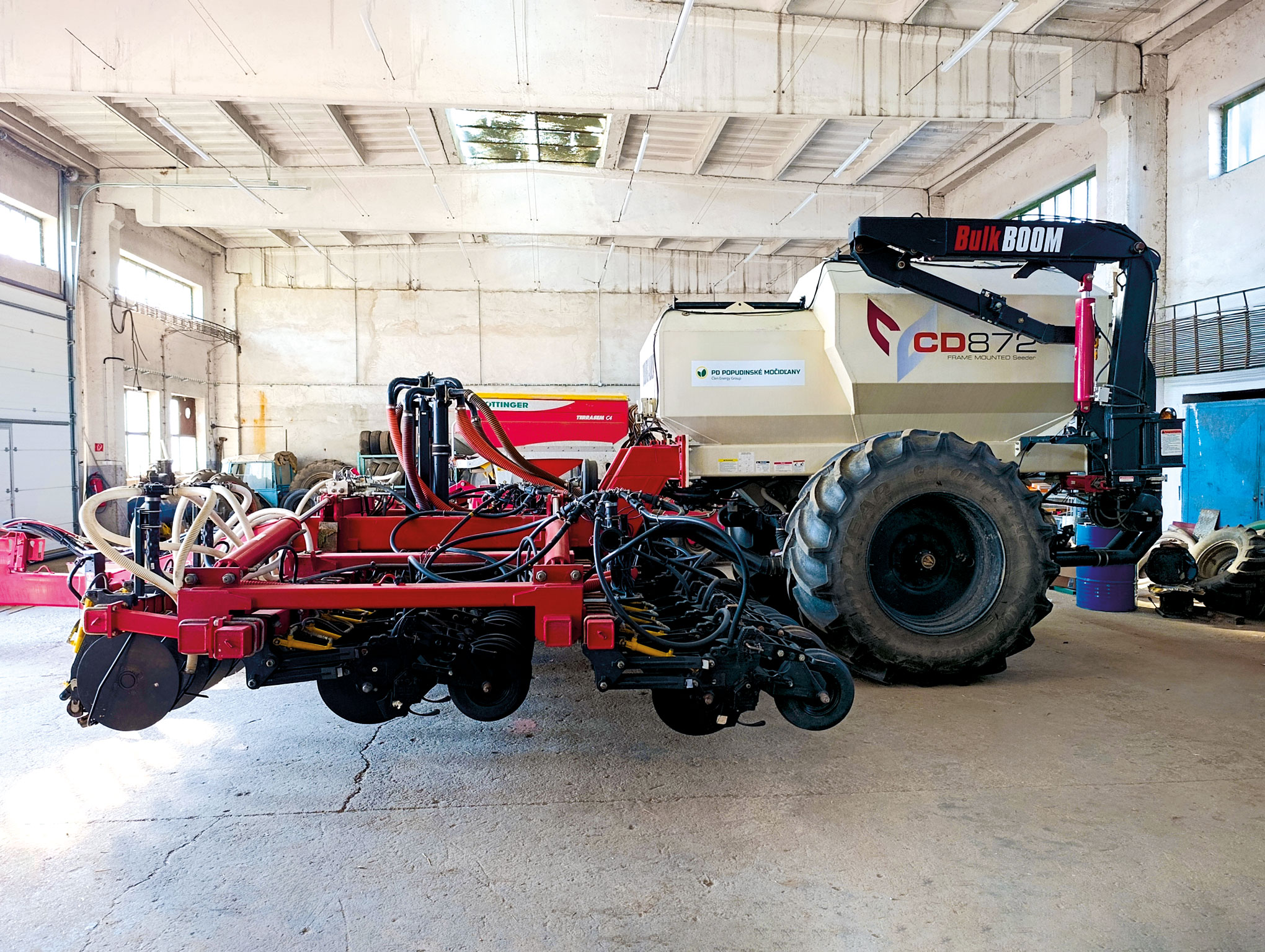
It is an advanced pneumatic seed drill with an integrated FMS (Frame Mounted Seeder) hopper and a working width of 6 metres, designed for highly precise sowing using No-Till technology. The machine combines a robust disc seeding frame with a high-capacity metering hopper in a single compact unit. To simplify loading, it is equipped with a Bulk Boom™ loading arm, designed for handling large bulk bags.
The KNEX™ hopper has a total capacity of 7,200 litres, divided into three separate compartments. This allows up to three different products – seed, fertiliser and microgranules – to be metered independently and applied simultaneously.
Key technological and technical advantages
- ParaLink™ parallel linkage ensures that seed is placed at the precisely selected depth, regardless of uneven ground conditions.
- The integrated FMS concept eliminates the need to tow a separate seed cart, resulting in a minimal turning radius at headlands.
- Compact transport dimensions: Thanks to its sophisticated folding system, the machine has a transport width of no more than 3.0 metres, meeting strict legislative requirements for legal transport on public roads.
- High downforce for No-Till seeding: Heavy-duty discs with exceptionally high downforce easily cut through even thick layers of crop residue and penetrate hard soil, ensuring reliable performance during direct seeding.
What is No-Till farming?
The basic principle of No-Till farming is simple: leave the soil undisturbed. Instead of conventional tillage, which significantly disrupts the soil structure, seeds are placed directly into untilled soil through a protective layer of crop residue known as mulch.
This layer, left behind after the previous crop, is not waste but a valuable resource. It:
- retains soil moisture and reduces water evaporation;
- helps prevent erosion caused by wind and rainfall;
- suppresses weed growth;
- gradually decomposes, enriching the soil with organic matter.
In this way, the soil’s natural biological balance can be restored. A healthy, balanced ecosystem supports greater populations of earthworms, fungi, bacteria and other microorganisms, all of which contribute to fertile, biologically active soil.
In the past, preparing a field for sowing required several passes – ploughing, disc harrowing, cultivation and finally seeding. With No-Till technology, the entire process can be reduced to a single pass, with seed placed directly into untilled soil.
This can reduce fuel costs by up to 60%, extend the service life of agricultural machinery and lower CO₂ emissions. No-Till farming is therefore not only more environmentally sustainable, but also offers significant economic benefits.